
Blog · 20 August 2026
Choosing an IATA crate — and teaching your pet to love it
The four measurements that decide the crate size, the build details airlines actually check, and a four-week plan that makes travel day ordinary instead of frightening.
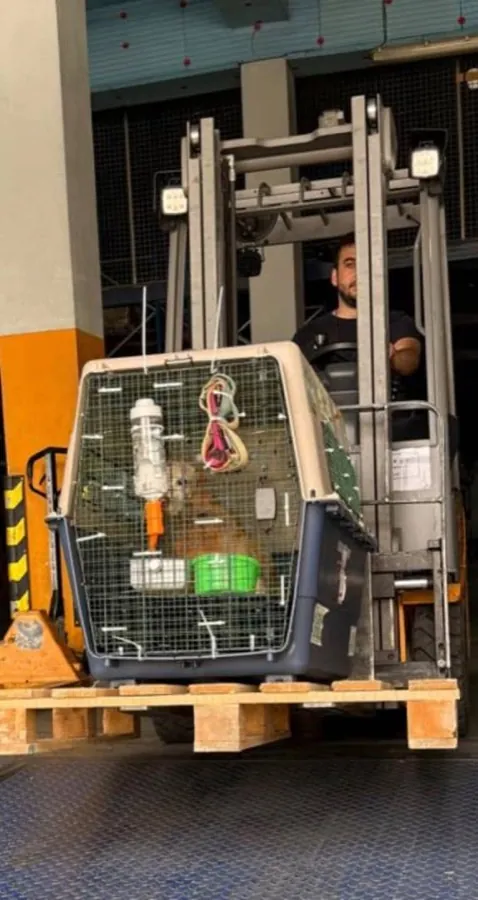
The crate is the part of a relocation owners tend to buy last and worry about least. It is also the part that gets pets refused at the counter.
Four measurements
Take these with your pet standing naturally on all four feet — not sitting, not stretched out, not mid-yawn.
- A — Length: nose to the base of the tail
- B — Height at shoulder: ground to the top of the shoulder
- C — Width: across the widest part of the shoulders
- D — Full standing height: ground to the top of the head, or to the ear tips if the ears stand up
The crate's minimum length is roughly A plus half the height from the ground to the elbow. Its minimum width is about twice C. Its minimum internal height is D, with clearance.
If your pet is still growing, measure again closer to departure. A crate sized for a seven-month puppy is often refused for a ten-month one.
The test an airline applies
Whatever the numbers say, an acceptance agent applies three practical checks. Your pet must be able to:
- Stand fully upright without their head or ears touching the roof
- Turn around comfortably
- Lie down in a natural position
Fail any one and the crate is refused. This is why we would rather check a crate weeks early than watch it fail on travel day.
What makes a crate compliant
The IATA Live Animals Regulations govern how the crate is built, not just how big it is. At acceptance, expect these to be looked at:
- Rigid, hard-sided construction. Collapsible fabric carriers and wire-only crates are not accepted for the hold.
- Ventilation on the required number of sides — not just the door. Some routes require ventilation on all four.
- A metal door with a secure locking system. Plastic-only doors and latches are a common refusal.
- Bolted fastenings. The two halves of the shell must be bolted, not clipped. Many crates are sold with plastic clips; those get replaced with nuts and bolts.
- Water and feed bowls fixed inside and fillable from outside without opening the door.
- Absorbent bedding with nothing loose that can shift in flight.
- Live Animals labelling, upright-orientation arrows and your contact details securely attached.
- Wheels removed or locked, depending on the airline.
You can buy your own crate — plenty of people do — but bring it to us before you book flights. Checking it is quick and free, and it beats discovering the problem at the counter.
Do not sedate
This deserves its own heading because it is asked so often.
Sedation is generally advised against for air travel, and many airlines will refuse a sedated animal outright. Altitude affects breathing and temperature regulation. A sedated pet cannot brace or right itself if the crate shifts during loading. The risk is real and the benefit is imaginary — a sedated animal is not calm, it is impaired.
The genuine alternative is preparation.
A four-week crate plan
The goal is simple: by travel day the crate should be somewhere your pet already chooses to sleep.
Weeks 1–2 — open door, no pressure. Put the crate somewhere your pet already spends time, door open and fixed back so it cannot swing shut. Feed them near it, then in the doorway, then just inside. Do not close the door at all in this phase.
Weeks 2–3 — make it the good place. Meals go in the crate. So does the favourite toy and a blanket that smells of home. You want them wandering in on their own when nothing in particular is happening.
Weeks 3–4 — short closed-door spells. Close the door for a minute while you stay in the room, then two, then five. Always open it before they get anxious, never after. If they whine and you open the door, you have taught them that whining opens doors.
Final weeks — longer stays and movement. Build up to a couple of hours, then take a short car trip with them in the crate. Being lifted, carried and moved should be familiar before it happens in a terminal.
Cats
The same principles, with more patience. Cats generally need longer to accept a new object in the house and respond well to the crate simply existing, open and ignored, for a week before anyone tries anything. Feed close to it, then in it. Never force a cat into a crate during training — one bad experience undoes a fortnight of good ones.
On the day
A familiar blanket goes in. Feed lightly rather than fully. Give water right up until acceptance, and we top up the fitted bowl. Then the crate is labelled, checked and accepted — and, in our experience, the pet that has slept in that crate for a month settles within minutes.
Ready to size one? Send us the four measurements, or bring your pet in and we will take them.